Friday, 7 November 2014

Savanna Bird Course

The Savanna Bird Course has started and, if the first weekend’s sightings are a sign of things to come then we are in for a real treat!

After an entertaining lecture by Ulrich Oberprieler entitled “Birds: Our Fascinating Friends” we were all set for the weekend’s birding.

 We had learnt about the characteristics of birds, the basics on migration, bird communication and what characteristics to look for when identifying birds.
 
Saturday morning arrived and, after a very early alarm call, we met at Marievale Bird Sanctuary (near Nigel) for a 5:30 start.

 It was a chilly 12˚C as we enjoyed the spectacular sunrise waiting for the gates to open.

Some of us don't get to see a sunrise very often...
 
We soon forgot about the early wake-up call as we started to identify the specials the wetland area has to offer. A total of 90 species were identified by the various groups.
 
Specials included the African Snipe, Black-Crowned Night Heron, Black Heron, African Marsh Harrier and Ruff (with the non breeding male white morph causing much debate).

It was amazing how many species we saw in a short space of time!
On Sunday morning we headed to Rietvlei Nature Reserve and, with the rain still falling, we started our birding at the Bird hide at Marais Dam. 

The rain eventually stopped and the weather started to clear but, unfortunately, we didn’t get to see the sun.

We ticked off some nice waterbirds and a variety of grassland species. A total of 88 species were identified. 

Specials included the Anteating Chat, Cape Grassbird, Malachite Kingfisher, Cape Longclaw, Fan-tailed and Long-tailed Widowbirds.

Despite the gloomy weather, everyone turned up!
The day’s outing ended for most with a nice warm cup of coffee or hot chocolate at the Rietvlei Coffee shop whilst we watched three white rhinos enjoying their breakfast. 

The ANT Blog
(with grateful thanks to Rod and Jenny Bell for the text and images)

The Black Heron has special significance to us :-)

Pied Avocet with an amazing recurved bill

African Snipe next to a male Ruff in non-breeding plumage


There were plenty of Red-knobbed Coots


Levaillant's Cisticola - a wetland favourite!
Cape Longclaw, displaying a beautiful orange throat


Magnificent male Long-tailed Widowbird in his breeding plumage!

Friday, 31 October 2014

All Refreshed!

Sunset at the dam, which was really more of a puddle - end of dry season
Lesser Bushbaby peeping out from the roof - photo Rod Bell
Recently, twenty three Africa Nature Training students (NEC alumni and a few correspondence course students) enjoyed an awesome weekend in the Waterberg Mountains. No pressure, no notes, just pure enjoyment! 

 As usual the ANT team laid on a full weekend’s entertainment, very different from our usual course weekends, with four teams and four very different activities.

It was fantastic to meet students past and present, and share information and ideas - a great way to learn and make new friends.

Most participants arrived on Friday evening and, after a leisurely walk round the farm, we settled in to watch ‘Bush TV’ with a difference. 


Not only did we have a lovely fire burning, but wagers were exchanged as to what time the resident Lesser Bush Babies (Galago moholi) would emerge from their roost under the thatch of the lapa. 

Watching bush tv!


It was great fun watching them (watching us!) and eventually by 18:35, they had all emerged and disappeared into the surrounding trees to forage.

Saturday morning started early with practical tracking. We tracked the usual suspects and even found the spoor of a few specials, including Puff Adder, Brown Hyaena and African Civet (including pastings).

For me, though, the highlight had to be the fresh Water Monitor spoor we found at the dam. It was so fresh, even impressions of the scales on the reptile’s foot were visible!


Andre found a grasshopper and showed us the tracks they make!
 
Fresh Water Monitor track with scales visible

Puff Adder track, with diagnostic 'tail drag' through the middle
After a tea break, we headed out for a re-cap of the trees in the area. Most trees had new spring growth so keying out species new and old was an excellent refresher. 

We also had a chance to identify André Veenstra’s collection of indigenous bonsai trees. 

I must admit that the miniatures were far trickier to identify than their grown-up cousins. Just shows how much we rely on the 'jizz' (GISS) of the tree for identification purposes!

After a long siesta we headed out on an interpretive walk. The brief was for each team to use their knowledge of the medicinal uses of indigenous plants in order to find a cure for Ebola using various plants found on Andanté. So, with books in hand, we started to research and find specimens for our various remedies.


Doc 'shake-shake' Veenstra in action, shaking those bones
The teams all met at the dam for sundowners and delicious snacks, laid on by the ANT team, but before we could relax and enjoy the surroundings we had to present our ‘Ebola cures’ to the visiting Sangoma, Doc ‘Shake-Shake’ Veenstra.

At sunset we strolled back to the Lapa and enjoyed a lovely evening round the fire sharing bush stories, with some reminiscing a little longer than others!


Birders putting their skills into practice
It was an early start on Sunday for our bird ID walk. We spotted LBJ’s, raptors, passerines and a very special colour morph!

We then met back at the Lapa for a team quiz challenge. Nicky certainly outdid herself here, creating a quiz with three sections (trees, spoor & birds) that encouraged great debate between team members and some serious searching of the ‘grey matter’ for answers. The Nyala team were ultimately victorious with 30 points!

Boil-treating the seeds that had been collected
During our weekend activities we collected various tree seeds and, having soaking them overnight on Saturday, we had the opportunity to plant them out under the guidance of André on Sunday morning.

Hopefully his tuition will enable us to propagate our own little indigenous bonsai trees.

Adding seeds and potting soil to seedling trays
After a sad farewell to friends new and old, we vowed to return in 2015!

So, make a note in your diaries now for the ‘2015 ANT Refresher Course’ which is set for the weekend of 10th and 11th October 2015. Book early to avoid disappointment!

The ANT Blog

(With grateful thanks for text and images to Jenny and Rod Bell)


Students doing a bit of revision on identifying trees

The Puzzle Bush (Ehretia rigida) in flower - gorgeous sight!

Camphor Bush (Tarchonanthus camphoratus) - we tried, this time unsuccessfully,
to light our fire using the flowers, but decided in the end that they simply weren't dry enough!

From left to right: Anne, Kevin, Carla, Andre, Jason, Gert and Pat

Monique and Sabine posing with the star of the show!

Is that an African Pipit?

Purse-like nest of a Grey Penduline-Tit

Dave and Carla set off with their group on a bird walk

Friday, 24 October 2014

Summer is here... and the bush is alive!

Hi there everyone!

It seems as if the bush has transformed overnight. The long-awaited rains have brought upon new life and a new energy in the bush as everything has suddenly come to life! The dust has settled. The dry grass and leafless trees are a thing of the past. Previously burnt areas are now sprouting fresh, nutritious new-growth grass which attracts a variety of grazers and thus predators as well...
The Wild Dogs drinking
What a sight!

Despite all the amazing sightings we had the first two weeks of the FGASA level 1 course, the last couple of days have been even better! The density of game is increasing now that the conditions are becoming favorable for all life - big and small. So favorable that we had the absolute delight of seeing one of the most endangered mammals in Africa... Wild Dogs! We had not only one, but two spectacular sightings of these wonderful canines. The first was as the family of dogs started to get active after their afternoon siesta. They stretched, scratched and then decided to drink water from a rock pool which provided for the most beautiful setting. The following day we sat with them for at least half an hour studying their behaviour and habits. There were around twelve dogs including four pups which are very quickly starting to grow in size! We had a good laugh as they rolled and yapped just like a domestic dog, even biting off bits of grass with their tails continuously wagging. It was breathtaking!

Our students have also started driving the game-viewer in preparation for the final assessment. We are making good progress and the understanding of nature is becoming all the more clear. Everyone can now give an excellent pre-departure brief and entertain guests with many interesting facts about not only mammals, but the smaller things like termites, trees, birds and much more! Very soon it will be time for them to work and gain valuable experience at the lodge in various departments as well as to 'shadow' the field guides to see how everything works together in the tourism industry. Exciting!
The young male leopard
Male lion and his meal


Another unforgettable scene took place yesterday as we ventured in to the south of the reserve. Ashlee (one of our students and an excellent spotter) somehow spotted a leopard next to the road. He is a well known, recently independent male leopard around two years old. Little did we know this was only the beginning as, a few minutes later, we came across an impressive, magnificent male lion! He had made a buffalo kill the previous night and we were fortunate enough to see him feeding on his well-deserved meal! The buffalo must be at least three times heavier but he manoeuvered it as if he was flipping a pancake. To see this power was an eye-opener for us all... As we sat and observed the lion feeding, a couple of Hooded Vultures arrived at the scene to scavenge on possible scraps left behind. The lion was not too impressed with this, of course, as he frequently chased the large raptors away. No words can describe that overwhelming feeling whilst looking at something like this. Amazing!

It never ceases to surprise me how much mother nature has up her sleeve. Every single day is a story waiting to be told. Let's see what happens next!

The ANT Blog

Hooded Vulture on the left, with two White-backed Vultures in the background

Magnificent White-backed Vulture in flight

That power...
Smile!
More Buffalo

A Chin-spot Batis in her nest

That expression! (and look at the Buffalo's tongue)

Saturday, 18 October 2014

The two-month FGASA level one course starts with a bang!

Hi there everyone!

The full-time FGASA level one course has begun and what a super start it has been! We have another excellent group of bush-lovers and we are already starting to build the bigger picture that is nature...


Everyone settled in very quickly here at Nkombe Camp, as you are surrounded by nothing but true wilderness. No man-made sounds, no artificial lights in the surrounding environment... only spectacular African bushveld. We all sat around the mesmerizing fire and got to know each other followed by Mandla's signature potjie (stew) to make everyone feel right at home ;)


Day one was brought to life by the most amazing sunrise and a concert of melodious bird calls (most of which our students can now identify). We went for a relaxing game drive to introduce everyone to the incredible area we are so privileged to be a part of - the greater Kruger National Park!

Walking in the bush...
The first morning walk was an absolute delight! We spent most of our time identifying new tracks, trees and birds and then soon the intense alarm call of a tree squirrel!

We immediately followed up to see what all the chattering was about when all of a sudden we found the culprit... a gorgeous female leopard walking (oh so elegantly) on the opposite bank of a dry river bed. This incredible sighting was brief but unforgettable for us all!
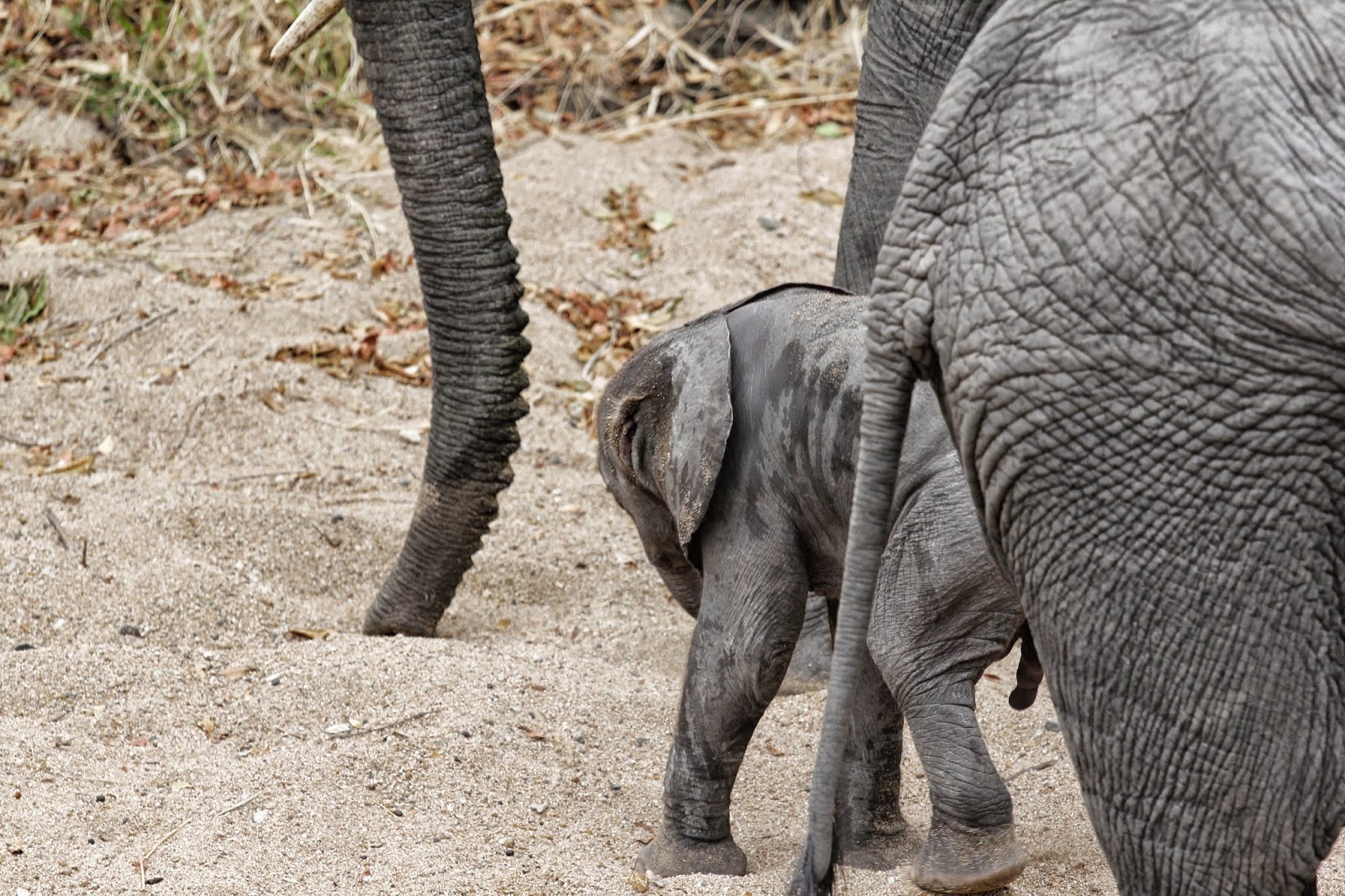
The new-born elephant!
The elephants decided to welcome the students to the bush as they decided to stick around camp for a couple of days. This made for great game viewing from the front of our tents as we observed these magnificent creatures feeding and even sleeping in the heat of the day whilst standing under the surrounding Jackalberry trees.
 
We even had the pleasure of seeing the cutest, clumsy elephant calf... only hours old. The youngster could hardly walk as mom gently nudged the baby with her trunk to cross a riverbed. What a sight!

The three lionesses
On one particular evening we heard the bone-chilling moans of Africa's largest cat... lions! Even though we know these calls can carry for over seven kilometres, we definitely knew this was close, very close. It turns out they were less than five-hundred metres from camp!

We had a wonderful, private sighting of three impressive lionesses as they laid in the soft sand of a dry river bed. They seem to be lactating which means we might have the opportunity to see the cubs in the nearby future! This was yet again another spectacular sighting...
The leopard cub explores new terrain

As if spending more than seven hours a day out in the field learning about nature is not enough to get you excited... nature surprised us again with another marvelous sighting.

One of our students (amazingly) spotted a small, spotted tail hanging from a Weeping Boer-Bean tree. As we drove closer to investigate, we found that it was a young leopard cub feeding on a Nyala kill! We couldn't believe our eyes as we watched the scene unfold. But where was the mother? We spent quite a bit of time observing the adorable cub as she continued feeding... until she dropped her meal to the ground. She briefly looked at us before clumsily heading down the tree to reclaim her food after which the cub disappeared into the distance. We thought we had lost her when we found the mother lying in a tall stand of Red Grass. The leopards were amazing to see and it was such a rare and incredible experience which will stay with us forever...

This course is truly amazing as we have the privilege to see the transformation of the bush. Everything is now coming to life as the first rains have arrived and rejuvenated the earth! The tortoises are back, as well as most of the insects and reptiles. The evenings are beginning to gain character with the continuous calls made by surrounding frogs. The trees are starting to flower and regain their brilliant canopies. It is amazing to witness!

If all of this can happen in just over ten days... then I can't wait to see what the next couple of weeks have in store for us!

The ANT Blog
(A special thank you to Henrico Muller for all of these beautiful photographs!)
"Sundowners" in the bush


That stare...
 
An incredible close-up of a lioness

An approaching storm...
Just a fraction of a massive buffalo herd!
 
More of the leopard cub...