Showing posts with label Savanna Bird Course. Show all posts

Wednesday, 26 August 2015

For the Birds!

Sunset at Andante Game Farm - one of the views that all South Africans treasure!
Photo credit: Justin van Doorene
“In order to see birds it is necessary to become a part of the silence.”
Robert Lynd

"Be as a bird perched on a frail branch that she feels bending beneath her, still she sings away all the same, knowing she has wings."
Victor Hugo


This morning, Trevor Hardaker posted a question on the Facebook page of BirdLife South Africa.

Trevor is a well-known personality in birding circles. In 2007, he became only the second person ever to pass the magical 900 mark on his Southern African list, sharing this milestone with the legendary Ian Sinclair. He currently serves as the chairman of the South African Rarities Committee.

Together with John Graham he also runs Zest for Birds, a pelagic trip and
bird guiding company.
Source: http://www.hardaker.co.za/about.htm
Throughout the day, this has received (and no doubt will continue to receive) a flurry of comments and 'likes' and replies from across the birding fraternity all over South Africa.

As we begin to tangibly feel the onset of spring in Gauteng, Africa Nature Training is getting ready for a busy period of peak bird-watching...summer is coming!

We think that Trevor's question and the responses people have provided show two important things that are worth noting and writing about:

1. South Africans are interested in birds!
2. This interest takes various forms.

The first point (which is also mentioned in one of the responses), is that South Africans are blessed to have such an abundance and variety of our feathered friends!

Where else can you go to such an array of habitats and encounter hundreds of birds during the course of one day?!

This is a highly rewarding hobby for anyone who takes an interest, no matter what the form. It could be that you feed the birds that visit your garden.

Perhaps some of them are even nesting in your garden and you simply observe the process. It could be that you notice every bird you see as you take your dog for a walk around the park.

It could be that you take binoculars and watch birds wherever you go on holiday. It could be that you spend every spare bit of time looking for more new species to add to your 'life list'. It could be that you participate in citizen science by regularly 'atlassing' and providing data for SABAP2.

Southern Yellow-billed Hornbill
It could be that you actively support NGO's in their efforts to save bird species. It could even be that you hear about a rare vagrant and spend vast amounts of time and money dashing across local, regional or international boundaries to look for it.

Orange-breasted Bush-Shrike - Photo credit Catherine Earnshaw
Whatever the form, we would like to encourage you to take an interest in birds! As well as being beautiful creatures in their own right, they have really interesting biology...if only people would take the time to notice.

What better way to spend your time than to focus on something good and pure...rather than on the 'not so positive' things that bombard us every day in the media.

If you would like to step into this wonderful world of birds but have no idea where to start, we are offering a part-time Savanna Bird Course to Gauteng residents that starts with an evening lecture on 4th November and ends with a weekend away to Nylsvley Nature Reserve on 29th November. Please contact our office for further details or to book your place: 012 667 5440 or info@AfricaNatureTraining.co.za.

The ANT Blog

Friday, 16 January 2015

New year, new beginnings...

Happy New Year everyone!

All of us at ANT hope that you had ample opportunity to rejuvenate during the festive period. Just before we closed for the year in 2014, we received an e-mail from the Chairman of the Black Eagle Project Roodekrans (who attended our Savanna Bird Course), which we thought you might find interesting, even though it's not exactly 'hot off the press' now.

Hi All,
It has been some time since I last updated you on what is happening.
Our juvenile “Jono” is still in the natal area although the aggression towards him has started to escalate, and it won’t be too long now before he will have to leave and fend for himself. The latest newsletter below will explain this a little more.
The project itself received a huge financial boost on Monday this week when Silverstar Casino handed over a cheque for R 157,433.50 to us at a special function. Their support for our work has been absolutely amazing and we are indeed privileged to have them as our main sponsor. Watch our Facebook page for a full report, and we also hope to see the Press coverage in the next few days.
Remember our website address is
www.blackeagles.co.za
Regards
Gerald Draper


Jono, an immature Verreauxs' Eagle, surveying the gardens before he was forced to leave forever
A note about the naming of the offspring by the 'Black Eagle Project Roodekrans':
Jon Oliver, CEO of Africam.com sadly passed away just a few days before Emoyeni's chick was born in June 2014, therefore, we think it only fitting that this eaglet should be named 'Jono', which is what he was always called by his friends and family.


The juvenile Verreauxs' (Black) Eagle had only been off the nest for six and a half weeks when the first unsuspected parental blows of aggressive behaviour struck him during the weekend of 25/26 October!
12 November 2014:
This behaviour is deemed far too soon by any standards for this species and should only have commenced during the tenth week, post fledging. Having thus requested that the 'Black Eagle Project Roodekrans' members specifically monitor this behaviour, the juvenile had been fortunate in that there did not appear to be too much conflict during the following week and weekend, thus being quite relaxed.
 
It's not fun having your parents turn on you so aggressively...
The calm before the storm was short-lived in that a major onslaught rained upon him from all directions on Saturday 8th November, with the female contributing for the first time too! One can only imagine how the juvenile must have felt…here he is biding his own…his parents bring him prey…he still roosts on the nest…then without any warning whatsoever the adult pair launch a very aggressive and prolonged attack upon him, and as the proverbial saying goes “you have to be cruel to be kind” rings true in this regard under these circumstances! Some of the most hardened avian photographers that have been recording the onslaught mentioned that at times it was too difficult to observe as the juvenile called incessantly in his attempt to escape the blows, be it in flight or perched…his world is coming down on him…fast and furious! Interestingly however, that Sunday, 9th November, was a quiet day with no aggression noted…as if nothing happened, which will confuse the juvenile even more in the days to come.
 
Jono will have no choice but to leave his parents' territory
Ultimately, in an effort to escape the relentless harassment, the juvenile will gradually be pushed out of its natal home range (territory) by the adults, which is a gradual process that can last two or three weeks and, during this period, he is unable to return to the nesting gorge that was his home since hatching five months ago. One can really feel for him, he will soon be unable to sleep on the nest that was his comfort zone and will be obliged to roost in a tree just like his parents have been doing…something he is not used to...yet.

As mentioned in October, it is imperative that the juvenile achieves 100% in all his subjects as, without these qualifications, his chances of survival lessens should he be unable to grasp the importance of tuition during the post fledging stages. Sleeping on the nest during the first month after fledging is acceptable, but not during the second month and beyond...mainly because when he is shoved out of the home range area, there will be no nest anywhere that awaits him and suddenly his own instinct will have to be engaged to ensure that he must roost out of harm’s way…most preferably on a sheer inaccessible rock face or a tall secure tree.

More so, he has never been taught to hunt, he has never accompanied his parents on a hunting sortie and, for as long as he has been at the nesting gorge, prey has always been delivered to him and all he had to do was consume. Whilst he is yet within the home range, they will continue to feed him, but not too frequently and possibly only half a meal every two or three days maybe more. Quite inadequate for a growing juvenile and instinct will once again drive himself to hunt his own prey and this may be difficult as he will never be certain of a successful hunt. During the first few attempts, he may only get lucky once in every tenth try, which is particularly nerve wracking! On the positive side though, whilst growing up from chick to eaglet to juvenile stages, he had imprinted all the prey types that were brought to him and this should give him a head start to survive as he will recognise the items within a split second of seeing them and specifically hunt that prey type. It is finding these that will put him to the test once more...

Written by Bo van der Lecq,  Black Eagle Project Roodekrans
Photos by Ernest Porter
12 November 2014 - reproduced here with permission (and grateful thanks from ANT!)
 
Jono was last seen at Walter Sisulu National Botanical Gardens (Johannesburg) on 12th December 2014...and we wish him a successful future - hambe kahle Jono!
 
The ANT Blog 

Tuesday, 25 November 2014

Savanna Bird Course - part 2

It's Wednesday night again and the lecture begins with the ins-and-outs of getting your Savanna Specialist Bird Guiding qualification through FGASA.

After listening to the various elements involved, it seems pretty daunting...and I think we all have a newfound respect for our ANT lecturer, who obtained the qualification earlier this year. 

Evening lectures are held at Henley Business School
Southern Red Bishop male
 
Purple Heron
Malachite Kingfisher
Claire watches as Kagiso finds her target
 
Was it a bird...was it a plane...?
It was exciting to watch a pair of Cape Rock Thrush on the rocks
Saturday morning was another early start at the Walter Sisulu Botanical Gardens in Roodepoort. Gerald Draper, Chairperson of the Black Eagle Project (and one of our students), gave us some insight into the project.

The infamous Verreaux's Eagle pair, Thulane and Emoyeni, have successfully raised a chick this year - named Jono - who had his maiden flight on the 10th September.
 
Apparently there is some concern about the constant fighting between father and son over the territory. Unfortunately we didn’t get to see the birds in flight, but we did get a look at the family perched on a rock face in the distance, being harassed by the resident pair of Peregrine Falcons.
Male Cape Weaver
We wandered around the garden, then on to the Sasol Bird Hide, along the stream and ended at the spectacular waterfall.

A number of specials were seen: Verreaux’s Eagle (of course) and Peregrine Falcon top the list, followed closely by Striped Pipit (with its pleading chick!), Bokmakierie and a magnificent Purple Heron. After a thoroughly enjoyable morning of birding, we all met at the coffee shop for some well-deserved refreshments.

A total of 72 species were observed by the three groups.

Another first, although flightless, was the Koppie Foam Grasshopper (Dictyophorus spumans). This grasshopper extracts and stores the toxins from the plant on which it feeds (mainly Milkweed) and exudes them as foam when attacked! Its aposematic colouring certainly screams danger!

Koppie Foam Grasshopper

Birding in an urban setting: Bishop Bird Park
Searching for the elusive Cuckoo


On Sunday morning we had a leisurely and most welcome later start.

We spent a few hours wandering around Bishop Bird Park in Centurion, a lovely little nature reserve in the heart of suburbia.

The overcast weather made sightings difficult, but we still reached a total of 42 species...among which was 'the one that got away' and which looked suspiciously like a Great Spotted Cuckoo!

Once again there was more to keep our interest than birds. After the recent rains some bulbs of the Amaryllis Family had emerged giving us a beautiful display of bright pink.


A splash of colour, fondly referred to as 'Vlei Lilies'
 
The ANT Blog
(with grateful thanks to Jenny Bell for the text and images)


Fiscal Flycatcher or Common Fiscal...you decide...
 
The ubiquitous Helmeted Guineafowl


Friday, 7 November 2014

Savanna Bird Course

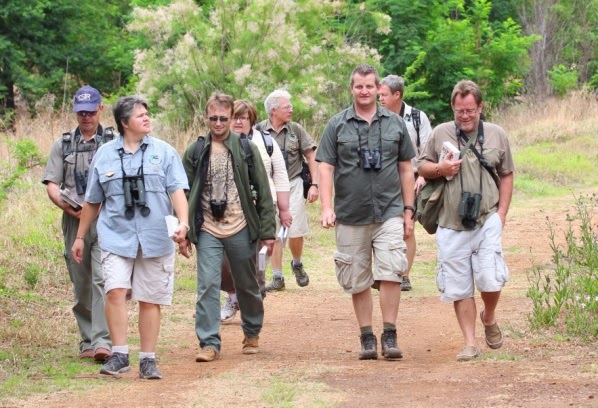
The Savanna Bird Course has started and, if the first weekend’s sightings are a sign of things to come then we are in for a real treat!

After an entertaining lecture by Ulrich Oberprieler entitled “Birds: Our Fascinating Friends” we were all set for the weekend’s birding.

 We had learnt about the characteristics of birds, the basics on migration, bird communication and what characteristics to look for when identifying birds.
 
Saturday morning arrived and, after a very early alarm call, we met at Marievale Bird Sanctuary (near Nigel) for a 5:30 start.

 It was a chilly 12˚C as we enjoyed the spectacular sunrise waiting for the gates to open.

Some of us don't get to see a sunrise very often...
 
We soon forgot about the early wake-up call as we started to identify the specials the wetland area has to offer. A total of 90 species were identified by the various groups.
 
Specials included the African Snipe, Black-Crowned Night Heron, Black Heron, African Marsh Harrier and Ruff (with the non breeding male white morph causing much debate).

It was amazing how many species we saw in a short space of time!
On Sunday morning we headed to Rietvlei Nature Reserve and, with the rain still falling, we started our birding at the Bird hide at Marais Dam. 

The rain eventually stopped and the weather started to clear but, unfortunately, we didn’t get to see the sun.

We ticked off some nice waterbirds and a variety of grassland species. A total of 88 species were identified. 

Specials included the Anteating Chat, Cape Grassbird, Malachite Kingfisher, Cape Longclaw, Fan-tailed and Long-tailed Widowbirds.

Despite the gloomy weather, everyone turned up!
The day’s outing ended for most with a nice warm cup of coffee or hot chocolate at the Rietvlei Coffee shop whilst we watched three white rhinos enjoying their breakfast. 

The ANT Blog
(with grateful thanks to Rod and Jenny Bell for the text and images)

The Black Heron has special significance to us :-)

Pied Avocet with an amazing recurved bill

African Snipe next to a male Ruff in non-breeding plumage


There were plenty of Red-knobbed Coots


Levaillant's Cisticola - a wetland favourite!
Cape Longclaw, displaying a beautiful orange throat


Magnificent male Long-tailed Widowbird in his breeding plumage!